US strikes Iranian oil tankers as Tehran targets American base in Jordan
Source: BBC World ↗ (cross-verified by 4 outlets — full list below)
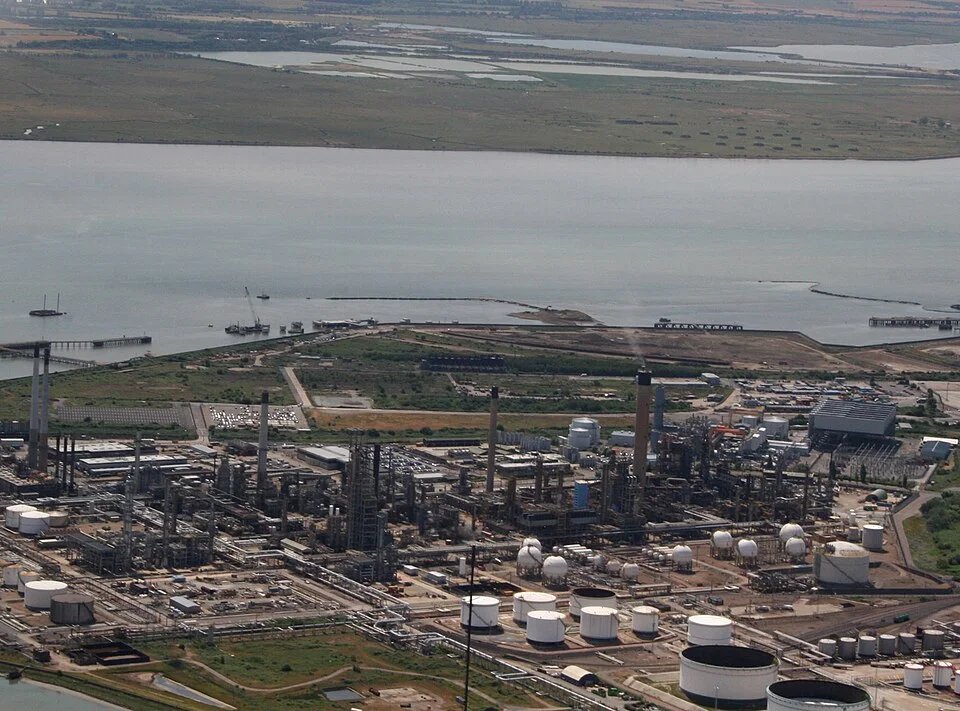
U.S. forces struck five Iranian oil tankers on Tuesday, sinking the M/T Riesco, after Tehran twice targeted an American warship with ballistic missiles that were successfully evaded, according to U.S. Central Command. The attacks hit four tankers linked to Iran’s Revolutionary Guard Corps (IRGC) in the Gulf of Oman and a fifth near Kharg Island, the country’s main oil‑export terminal where roughly 90 % of its crude passes through. In retaliation, Iran launched missiles at a U.S. base in Jordan, of which Jordanian forces shot down 18 of the 20 projectiles, while two fell in unpopulated areas; Iran also claimed to have struck two U.S. vessels and eight oil tankers in the Strait of Hormuz.
The escalation has pushed benchmark Brent crude toward the $100‑a‑barrel mark, with Brent up 1.5 % to $99.35 and U.S.‑traded oil 1.3 % higher at $94.23, reflecting heightened market anxiety over regional instability. Washington justified the strikes by describing the targeted tankers as part of a “multi‑billion‑dollar shadow network” that finances the IRGC and its proxies, while Tehran’s Revolutionary Guard warned of further attacks on “non‑compliant vessels” attempting to transit the Strait of Hormuz. The broader conflict follows a series of tit‑for‑tat actions that began more than six months after the U.S. and Israel struck Iran on 28 February, and coincides with a separate Houthi attack on Saudi energy facilities that injured dozens and temporarily halted production.
U.S. Secretary of State Marco Rubio framed the confrontation as “pretty straightforward,” emphasizing that each Iranian attempt to hit U.S. naval assets will be met with the loss of tankers. Meanwhile, the U.S. clarified that a malfunctioning, unmanned underwater drone—an older model without sensitive equipment—had been operating in the region, underscoring ongoing surveillance efforts. The latest round of strikes deepens the risk of further maritime confrontations, threatens global oil supply chains, and places neighboring states such as Jordan and Saudi Arabia on heightened alert as the Middle East’s security landscape grows increasingly volatile.
⚡ Effects Interpreter
🌍World Economylow impact
What this means for you
- ▶Global investors may reshuffle quickly as the story sinks in.
- ▶Bond markets may subtly reprice risk once this news circulates.
🏙️Local Economylow impact
What this means for you
- ▶The cost of a weekly food shop can creep up in the background.
- ▶Jobs and trade close to home might feel a soft knock-on effect.
🏦Rates & Bankslow impact
What this means for you
- ▶Fixed and variable borrowers alike could want to keep half an eye on this.
- ▶Borrowing costs may hold steady for now, but they can turn on fresh news.
❤️Healthmedium impact
What this means for you
- ▶Health anxieties triggered by this kind of news usually ease once facts replace speculation.
- ▶Checking in on vulnerable neighbours matters when news feels heavy.
💷Wealthmedium impact
What this means for you
- ▶It's tempting to watch the ticker, but patience typically pays off more.
- ▶The bigger the market move, the faster it often reverses.
🏠Housinglow impact
What this means for you
- ▶Any effect on bricks and mortar is likely to be slow and modest.
- ▶Surveyors and valuers tend to factor in wider trends gradually, not overnight.
🌍 Effects for your country
The U.S.'s central bank rate currently stands at 3.75%, so a global rates move like this could feed through to local borrowing costs. The U.S.'s economy is growing at 2.3% with inflation at 3.2%, the backdrop this story's effects play out against locally. Housing-market effects like this are usually felt most where mortgage rates track the U.S.'s own central bank rate closely. With the U.S.'s unemployment at 4.4%, personal-finance effects like this land on a labour market that is currently fairly stable. Health-system effects are harder to localise from economic indicators alone — the real impact in the U.S. depends more on local healthcare capacity than the figures above.
The UK's central bank rate currently stands at 3.75%, so a global rates move like this could feed through to local borrowing costs. The UK's economy is growing at 0.8% with inflation at 3.2%, the backdrop this story's effects play out against locally. Housing-market effects like this are usually felt most where mortgage rates track the UK's own central bank rate closely. With the UK's unemployment at 5.6%, personal-finance effects like this land on a labour market that is currently fairly stable. Health-system effects are harder to localise from economic indicators alone — the real impact in the UK depends more on local healthcare capacity than the figures above.
France's central bank rate currently stands at 2%, so a global rates move like this could feed through to local borrowing costs. France's economy is growing at 0.9% with inflation at 1.8%, the backdrop this story's effects play out against locally. Housing-market effects like this are usually felt most where mortgage rates track France's own central bank rate closely. With France's unemployment at 7.9%, personal-finance effects like this land on a labour market that is already under strain. Health-system effects are harder to localise from economic indicators alone — the real impact in France depends more on local healthcare capacity than the figures above.
Romania's central bank rate currently stands at 6.5%, so a global rates move like this could feed through to local borrowing costs. Romania's economy is growing at 0.7% with inflation at 7.8%, the backdrop this story's effects play out against locally. Housing-market effects like this are usually felt most where mortgage rates track Romania's own central bank rate closely. With Romania's unemployment at 6%, personal-finance effects like this land on a labour market that is currently fairly stable. Health-system effects are harder to localise from economic indicators alone — the real impact in Romania depends more on local healthcare capacity than the figures above.
The UAE's central bank rate currently stands at 3.65%, so a global rates move like this could feed through to local borrowing costs. The UAE's economy is growing at 3.1% with inflation at 2.5%, the backdrop this story's effects play out against locally. Housing-market effects like this are usually felt most where mortgage rates track the UAE's own central bank rate closely. Health-system effects are harder to localise from economic indicators alone — the real impact in the UAE depends more on local healthcare capacity than the figures above.